

Most people assume esports vocabulary is just gamer slang picked up in Discord servers. It isn't. Micro and macro are foundational concepts that separate casual players from professionals, and knowing the difference between ADR and ACS can change how a coach builds an entire roster. In 2026, the esports industry has professionalized to the point where shared language isn't optional. It's a competitive tool. This guide breaks down the terms that matter most, explains how to apply them, and shows you exactly why vocabulary is one of the most underrated skills in competitive gaming.
Table of Contents
- Why esports terminology matters in 2026
- Core mechanics: micro, macro, and beyond
- Performance stats and analytics: what really counts
- Tournament formats, training, and essential edge-case lingo
- Betting markets and esports data terms
- Ready to elevate your esports strategy?
- Frequently asked questions
Key Takeaways
| Point | Details |
|---|---|
| Micro vs macro | Mastering these terms clarifies communication and in-game roles for all team members. |
| Stats need context | Composite analytics like OSCAR give a fuller view of player performance than raw statistics. |
| Learn core lingo | Training and tournaments use specialized vocabulary every player should know to excel. |
| Evolving analytics | Advanced metrics and real-time data are now standard for competitive analysis and coaching. |
Why esports terminology matters in 2026
Precise language is the backbone of fast, effective team communication. When your IGL calls a rotation and half the team interprets it differently, you lose rounds. You lose matches. You lose opportunities. The gap between a team that communicates with shared vocabulary and one that doesn't is measurable in real outcomes.
As professionalizing esports teams raise their standards, they expect incoming players and staff to already speak the language. You won't get a tutorial during tryouts. Coaches now use analytics and terminology for scouting, feedback, and performance reviews, and if you can't engage with that feedback, you're invisible on the roster.
Understanding the full esports organization structure also depends on knowing the terms that define each role and responsibility. Here's what precise terminology does for your game:
- Reduces miscommunication during high-pressure moments
- Speeds up strategy execution in real time
- Builds credibility with coaches and team leadership
- Helps you absorb feedback faster and apply it correctly
- Makes you a more effective communicator in scrims and tournaments
Refer to a solid esports terms glossary to fill any gaps in your current vocabulary. The investment takes an afternoon and pays off for years.
"Micro wins duels, macro wins games. Pros balance both through IGL shotcalling that keeps individual skill aligned with team strategy."
Now that we've set the stage for why these terms matter, let's break down the essential categories you'll encounter.
Core mechanics: micro, macro, and beyond
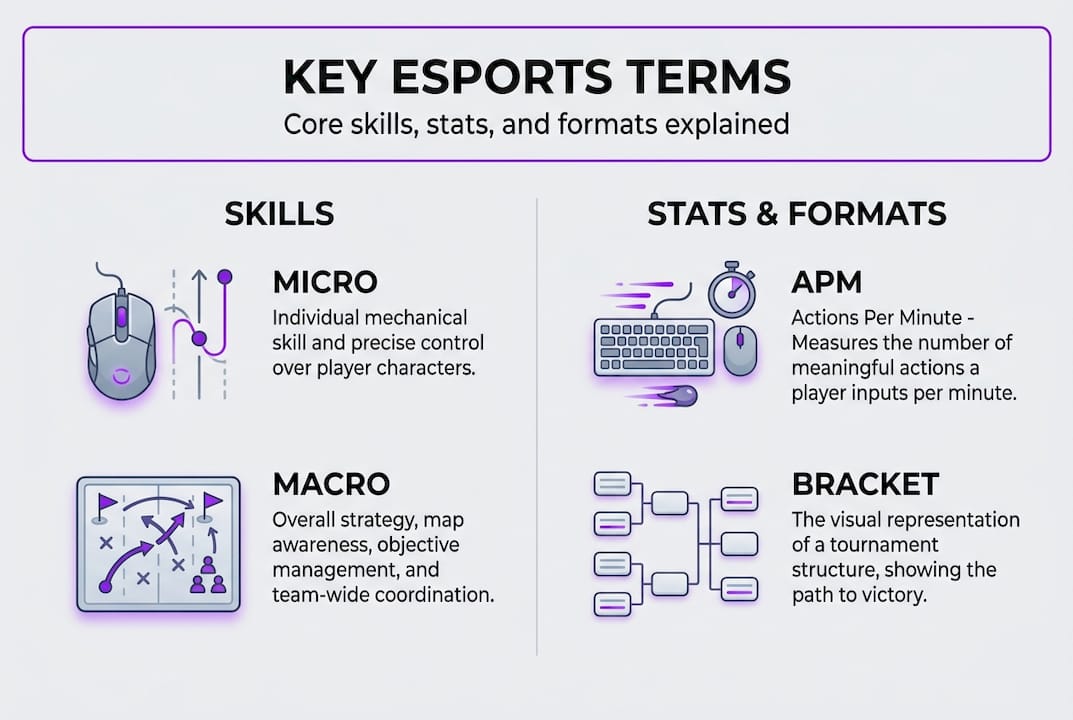
Micro refers to individual in-game skills. Aiming, movement, ability timing, positioning, and mechanical execution all fall under micro. It's what you're doing with your hands and your character in the moment. Macro, on the other hand, is the strategic layer. Rotations, economy management, map control, and team coordination are all macro decisions.
The micro vs. macro distinction is central to how coaches analyze performance. A player with elite micro but poor macro reads will plateau. A team with strong macro but weak individual mechanics will get punished in duels. The best players and teams develop both in parallel.
The IGL (In-Game Leader) is the player responsible for macro shotcalling. They decide when to push, when to fall back, which strategy to run, and how to adapt mid-round. Think of the IGL as the coach on the field. Their decisions shape the entire team's behavior in real time. Learn more about esports leadership roles to understand how the IGL fits into a broader team structure.

Other core terms worth knowing include positioning (where you place yourself on the map relative to threats and objectives) and rotations (moving from one area of the map to another in response to information). Both are discussed constantly in training for competitive esports and are non-negotiable vocabulary for any serious player.
| Term | Category | What it means | Example in context |
|---|---|---|---|
| Micro | Individual | Mechanical skill execution | Hitting a flick shot under pressure |
| Macro | Team/Strategy | Big-picture decision making | Calling a B-site rotate after A pressure |
| IGL | Role | In-Game Leader who shotcalls | Calling eco round or force buy |
| Positioning | Tactical | Map placement relative to threats | Holding off-angles to create confusion |
| Rotation | Movement | Shifting position based on info | Rotating CT-side after bomb plant |
| Shotcalling | Communication | Real-time strategic direction | Calling execute timing mid-round |
Pro Tip: Don't obsess over micro at the expense of macro. Players who grind aim trainers but never study rotations often stall at mid-tier ranks. Balance both and your ceiling rises significantly.
Having grasped the distinctions between micro and macro, it's time to dig deeper into the data-driven side of esports language.
Performance stats and analytics: what really counts
Numbers tell a story, but only if you know what they mean. Three acronyms dominate performance reviews in 2026: APM, ADR, and ACS.
APM (Actions Per Minute) measures how many inputs a player executes per minute. It's most relevant in real-time strategy games and MOBAs, where mechanical efficiency under pressure is a direct performance indicator. ADR (Average Damage per Round) tracks how much damage a player deals on average each round, regardless of kills. A high ADR player who doesn't always get the kill is still contributing meaningfully. ACS (Average Combat Score) is a composite metric used in games like Valorant that factors in kills, assists, damage, and first bloods to give a fuller picture of combat impact.
The shift to advanced biometrics and analytics in 2026 means teams are no longer relying on raw kill counts to evaluate players. Context is everything.
| Acronym | Full name | What it measures | Relevant game type |
|---|---|---|---|
| APM | Actions Per Minute | Mechanical input speed | RTS, MOBA |
| ADR | Average Damage per Round | Damage contribution per round | FPS (CS2, Valorant) |
| ACS | Average Combat Score | Composite combat impact | Valorant |
| K/D | Kill/Death Ratio | Basic kill efficiency | All genres |
| OSCAR | Composite framework | Multi-dimensional player value | Cross-title analysis |
Empirical benchmarks are role and map dependent. A support player's ADR will always be lower than an entry fragger's. Judging both by the same number is like comparing a quarterback's rushing yards to a running back's. The OSCAR framework addresses this by combining multiple performance dimensions into one contextual score, giving coaches a more honest picture of a player's real value.
Here's how to use analytics effectively as a player or coach:
- Always compare stats within the same role and map context
- Track trends over time rather than reacting to single-game numbers
- Use performance analytics in esports to identify patterns, not just highlight reels
- Combine quantitative stats with qualitative VOD review for full context
- Leverage structured training benefits to build systems around data, not just instinct
For a broader reference on metrics and acronyms, the esports stats glossary is a reliable starting point.
With stats mastered, let's explore the essential tournament, training, and edge-case terms that round out your proficiencies.
Tournament formats, training, and essential edge-case lingo
Knowing how tournaments are structured changes how you prepare. The three most common formats are single-elimination (one loss and you're out), double-elimination (you get a second chance through a losers bracket), and Swiss (teams are matched against opponents with similar records across multiple rounds). Each format demands a different mental approach and preparation strategy.
Bootcamp, scrims, and bracket formats are standard vocabulary in elite preparation. Here's a numbered breakdown of the core training workflow terms every competitive player should know:
- Bootcamp: An intensive training period where a team practices together, often in person, ahead of a major event
- Scrims (scrimmages): Practice matches against other competitive teams, used to test strategies and build team chemistry
- VOD review: Watching recorded match footage to analyze mistakes, identify patterns, and improve decision-making
- Dry run: Practicing a specific strategy or execute without opposition to build muscle memory
- Debrief: A structured post-match or post-scrim discussion where the team reviews what worked and what didn't
Edge-case tactics are where advanced players separate themselves. A jiggle peek is a quick side-to-side movement used to gather information about an enemy's position without fully exposing yourself. A one-way smoke is a smoke grenade placed so that one side can see through it while the other cannot, creating an information and positional advantage. Anti-eco refers to a round where the opposing team is playing with limited resources, and your team adjusts its strategy to maximize value while minimizing risk.
For a deeper look at how these terms fit into competitive preparation, the training process for esports and the competitive gaming guide are worth bookmarking. You can also explore tournament and edge-case terms for a broader reference.
Pro Tip: Practicing edge-case tactics like jiggle peeks and one-way smokes in scrims builds the muscle memory and confidence you need to execute them cleanly under tournament pressure.
As you integrate these into routines, let's quickly cover the interplay of data, betting, and the evolving industry boundaries.
Betting markets and esports data terms
Even if you're not personally involved in betting, understanding this vocabulary matters. Broadcasters use it, sponsors reference it, and data providers shape how your team's performance is tracked and reported publicly.
First Blood in a betting context is a market that predicts which team or player will score the first kill in a match. In-Play Betting refers to wagers placed while a match is actively happening, reacting to real-time events. A Data Provider is a company that collects, processes, and distributes live match data to broadcasters, analysts, and betting platforms. First Blood, In-Play Betting, and data providers like GRID are now integral to how the modern esports ecosystem operates.
Here are the key data operators and why they matter to teams:
- GRID: One of the leading esports data infrastructure companies, providing real-time match data to broadcasters and analysts
- Abios: A data and odds provider used by sportsbooks and esports platforms for live statistics
- PandaScore: Delivers live esports data and betting odds across multiple titles
- Riot Games Data: Title-specific data feeds used for official Valorant and League of Legends analytics
Real-time analytics providers fuel rapid tactical adjustments during live matches, giving coaching staff the data they need to make informed decisions between rounds or maps. Understanding this ecosystem also supports long-term growth in esports by helping players and organizations position themselves within a data-driven industry. For a full reference, the esports betting glossary covers the complete vocabulary used across markets and platforms.
With a full suite of industry terms, you're ready to apply, teach, and leverage this vocabulary with competitive confidence.
Ready to elevate your esports strategy?
Vocabulary is just the beginning. Applying these terms inside a structured, accountable team environment is where real growth happens. At Xyra Esports, we build competitive players through organized coaching, disciplined training programs, and a community that takes development seriously. Whether you're an aspiring player looking to break into competitive play or a coach refining your analytical approach, Xyra Esports provides the structure and resources to move forward. Join a team that speaks the language and plays at the level you're working toward.
Frequently asked questions
What is the difference between micro and macro in esports?
Micro refers to individual in-game skills like aiming and movement, while macro covers team strategy, rotations, and overall decision-making. Both are essential, and elite players develop them together rather than treating them as separate priorities.
Which performance stat matters most for aspiring pros in 2026?
Composite frameworks like OSCAR are more valuable than simple K/D ratios because they evaluate multiple dimensions of performance in context. A high K/D on a support player means less than strong ADR and utility usage combined.
What does IGL stand for in esports teams?
IGL stands for In-Game Leader, the player responsible for making real-time strategic calls during a match. The IGL's decisions directly shape how the team executes strategies and adapts to opponents.
How do tournaments use bracket formats?
Bracket formats like single-elimination, double-elimination, and Swiss determine how teams advance through a competition. Each format creates different pressure dynamics and requires teams to prepare mentally and strategically for varied scenarios.
What is 'First Blood' in esports betting?
First Blood is a betting market that predicts which team or player scores the first kill in a match. It's one of the most popular in-play markets because it resolves quickly and reflects early-game aggression and preparation.