

Most players grind mechanics for months, but the ones climbing ranks fastest share one overlooked habit: they speak the same language as their team. Esports terminology is not just insider slang. It is a functional communication system that separates reactive players from proactive ones. When your teammate calls "we're snowballing" or "hit your rolldown," you need to respond in under a second, not spend three seconds decoding what they meant. This guide breaks down the most essential esports terms, shows you how they work in real match scenarios, and gives you a practical framework for expanding your vocabulary fast.
Table of Contents
- Why esports terminology matters
- Core esports terms every player should know
- In-action: How terminology shapes team strategy
- Evolving language: New and game-specific esports slang
- Our take: Why mastering terminology is your secret esports weapon
- Take your esports journey further with XyraEsports
- Frequently asked questions
Key Takeaways
| Point | Details |
|---|---|
| Communication is crucial | Knowing esports terminology allows for efficient, clear teamwork and strategy during matches. |
| Learn core terms first | Start by mastering the most common phrases used in your game to avoid confusion. |
| Stay updated on slang | Esports lingo evolves; keep up with game updates and streams to know the latest terms. |
| Apply terms in practice | Use new terminology in voice chat and strategies to integrate it into your gameplay. |
Why esports terminology matters
Competitive gaming moves at a pace that leaves no room for confusion. A single miscommunication during a team fight, a rotation call, or a late-game push can cost you a round, a map, or an entire match. This is not an exaggeration. Teams at the highest level spend serious time building shared language because they know that industry terms explained are the backbone of effective strategy and in-game coordination.
Think about what happens in a competitive gaming environment when one player does not know what "rotate" or "peel" means. The team calls a play, that player moves in the wrong direction, and the window closes. The mistake was not mechanical. It was linguistic. That distinction matters because it changes how you train.
Here is what terminology fluency actually gives you:
- Faster decision-making: Shared terms compress complex ideas into one word, cutting reaction time.
- Clearer callouts: Saying "they're stacking macro" tells your team more than a five-sentence explanation mid-match.
- Faster learning: When you watch VODs or read guides, you absorb information quicker because you already know the vocabulary.
- Stronger team trust: Players who communicate using the right terms signal competence, which builds confidence across the roster.
- Better adaptability: Understanding genre-wide terms means you can transfer knowledge between games more easily.
"Mastery of esports terminology is key to effective communication and strategy in competitive matches."
Pro Tip: Start by mastering the terms specific to your main game. Once those feel natural, expand into genre-wide vocabulary and then tournament-specific language. Trying to learn everything at once leads to shallow retention.
The gap between a player who knows the terms and one who does not shows up most clearly under pressure. When the game is close and communication needs to be instant, terminology is the tool that keeps the team moving together.
Core esports terms every player should know
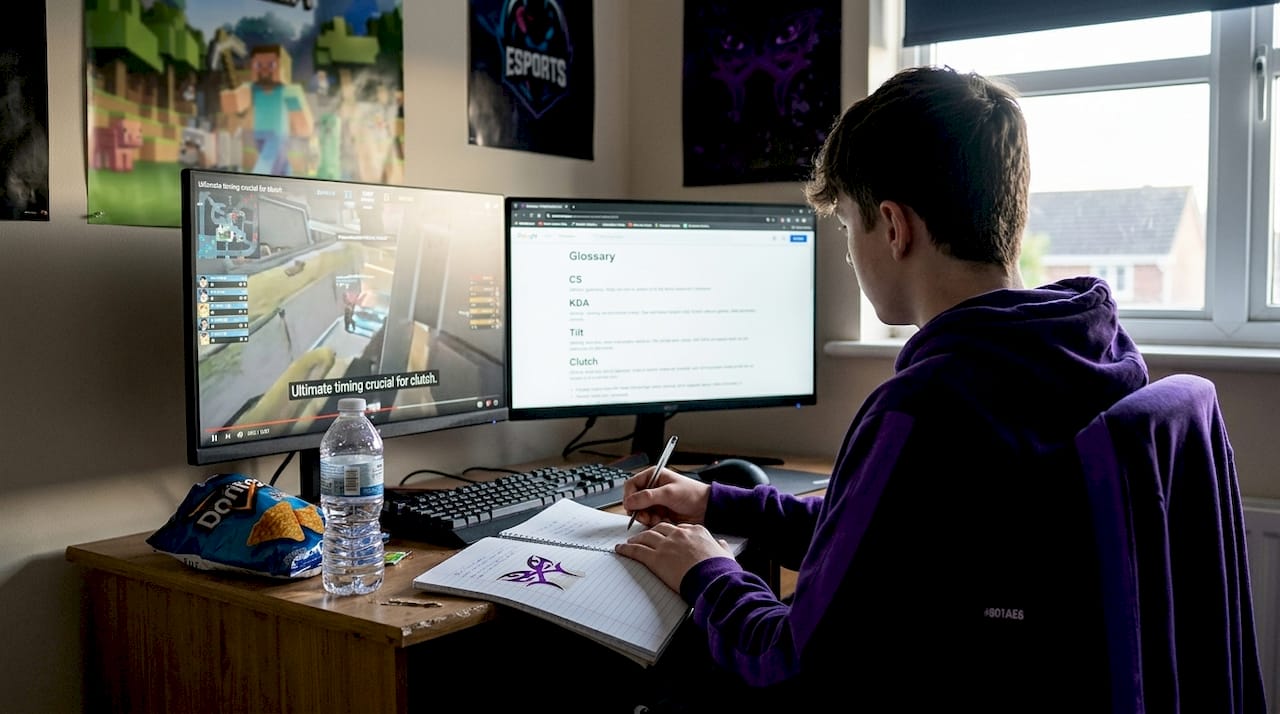
Now that you see the importance, let's break down key terms you need to know. These span multiple genres including MOBA, FPS, Battle Royale, and TFT, and many of them carry different weight depending on the game context.
| Term | Short definition | Genre relevance |
|---|---|---|
| Meta | The most effective tactics or builds at a given time | All genres |
| Role | A player's assigned function in the team | MOBA, FPS |
| Carry | A player who drives the team to victory | MOBA, Battle Royale |
| Support | A player who enables others to perform | MOBA, FPS |
| Strat | A planned strategy or approach | All genres |
| RNG | Random number generation, luck-based outcomes | TFT, Battle Royale |
| Rolldown | Spending gold quickly to find key units | TFT |
| High Roll | Getting lucky with strong early units | TFT, RNG games |
| Snowball | Building an early lead that compounds over time | All genres |
| Utility | Abilities or items that support the team rather than deal damage | MOBA, FPS |
| Tilt | A mental state of frustration affecting performance | All genres |
| Cooldown | The wait time before an ability can be used again | All genres |
| Macro | Big-picture strategy and map awareness | MOBA, RTS |
| Micro | Fine-tuned mechanical control of individual units or actions | MOBA, RTS |
According to TFT Glossary, Rolldown and High Roll are fundamental concepts in TFT and RNG-based games, and understanding them changes how you approach economy decisions entirely.
A few things worth noting about this list:
- Meta shifts constantly with patches, so staying current is part of the skill.
- Tilt is underestimated as a performance factor. Recognizing it in yourself or a teammate and naming it out loud can actually help reset the team's focus.
- Macro vs. micro is one of the most important distinctions in any team game. You can have incredible micro and still lose consistently because your macro decisions are poor.
If you want to see how these terms connect to gaming skills examples in practice, the overlap between vocabulary and execution becomes obvious fast. Knowing the term is step one. Applying it under pressure is step two.
In-action: How terminology shapes team strategy
Knowing what the terms mean is only half the equation. Here's how they function in a real match.
Imagine a TFT lobby in the mid-game. Your team is in a Discord call, and the situation is evolving fast. Here is how a terminology-fluent player communicates versus someone still learning the language:
- Early game: "I'm high rolling on two-cost units, going to commit to the carry comp." Everyone on the call immediately knows you got lucky with early shops and are building around a specific win condition.
- Mid game: "I'm at 50 gold, about to hit my rolldown at level 8." Your team knows you are about to spend aggressively to three-star your carry. They adjust their own pacing.
- Late game: "I snowballed early but the meta punishes my comp now. Need utility items to survive." In two sentences, you have communicated your win condition, your threat, and your item priority.
- Tilt check: "I'm tilting after that loss streak. Give me 30 seconds." Naming the mental state prevents it from bleeding into poor calls.
- Strat pivot: "Meta shifted. We're going macro mode, play for top four, not first." The whole approach changes with one call.
Notice how each callout is short, precise, and immediately actionable. That is what terminology does. It compresses complex game states into fast, shared understanding. Proper use of terminology allows faster decision-making during high-stakes gameplay, and that speed difference compounds across an entire match.
If you want to build this skill systematically, a solid training checklist will help you structure your sessions around both mechanical and communication goals. Pairing that with a step-by-step training guide gives you a clear progression path.
Pro Tip: Watch pro streams or VODs with the specific goal of catching terminology in use. Pause when you hear an unfamiliar term, look it up, and then watch how it plays out in the next 30 seconds of gameplay. Context is the fastest teacher.
Evolving language: New and game-specific esports slang
Beyond the basics, esports slang is constantly growing. Let's explore what's new or unique in different games.
The core terms above have been around long enough to feel stable. But esports language does not stay still. Every major patch, every viral pro play, and every popular streamer moment has the potential to birth a new term that spreads across the community within days.
| Classic term | Emerging or game-specific equivalent | Origin |
|---|---|---|
| Snowball | "Perma-stomp" | FPS community slang |
| Tilt | "Inting" (intentionally feeding) | League of Legends |
| Utility | "Peel" | MOBA team fight comms |
| RNG | "Dice roll comp" | TFT community |
| Meta | "Flavor of the patch" | Patch cycle discussions |
| Macro | "Macro-gaming" or "macro-play" | Coaching terminology |
Three main forces drive new term adoption:
- Patch notes: When a mechanic changes, players need new words to describe the new behavior fast.
- Pro players: A single pro using a term on stream can push it into mainstream use within a week.
- Memes and community culture: Some terms start as jokes and end up as serious strategic vocabulary.
Community-driven terminology grows and impacts game culture each year, reshaping how players describe and teach the game to each other.
The competitive edge here is real. Players who pick up new slang early adapt faster to patch shifts because they are already thinking in the new language. If everyone is still calling something by its old name while you are using the updated term, you are signaling that you understand the current state of the game.
Staying current with industry terms explained is not a one-time task. It is an ongoing practice, just like reviewing patch notes or watching pro play. The players who treat vocabulary as a living skill rather than a fixed list are the ones who stay ahead of the curve.
Our take: Why mastering terminology is your secret esports weapon
Here is the part most coaching content skips: mechanical skill has a ceiling that is hard to break through quickly. Terminology fluency does not. You can go from knowing zero terms to being fully conversant in your game's language within a few weeks of deliberate practice. That is a faster return on investment than grinding aim training for the same amount of time.
The players we see develop fastest at Xyra Esports are not always the ones with the best mechanics. They are the ones who communicate precisely, adapt their language to new patches, and actively study how top players describe the game. That habit compounds. Better communication leads to better team synergy, which leads to more wins, which leads to faster rank progression.
The most underrated daily habit is reviewing patch notes and leaderboard discussions specifically for new terminology. Make a short flashcard set. Join esports-focused Discord servers where high-level players talk strategy. The structured esports training benefits of combining language learning with mechanical practice are significant and measurable. Do not treat vocabulary as a side task. Treat it as a core skill.
Take your esports journey further with XyraEsports
Ready to put your new vocabulary to work and connect with a driven gaming community? At XyraEsports, we build structured environments where players develop both their mechanical skills and their communication game. Our resources cover everything from terminology guides and training checklists to competitive team opportunities across multiple titles. Whether you are just starting to build your esports vocabulary or you are already competing and want to sharpen your edge, the XyraEsports community gives you the tools, teammates, and coaching to keep growing. Visit the site and start building the habits that separate serious players from the rest.
Frequently asked questions
What does 'Rolldown' mean in esports?
In Teamfight Tactics, Rolldown means spending your saved gold quickly to find key units at the right level, usually to hit a three-star carry before your opponents do.
Why is esports terminology important for new players?
Mastery of esports terminology is crucial for clarity and strategic alignment, helping new players communicate faster and make smarter decisions alongside their team.
How do new terms become part of esports language?
Game communities and updates drive adoption of new esports language, with pro players, patch cycles, and community memes all accelerating how quickly a new term spreads.
What is the difference between 'macro' and 'micro' in esports?
Macro refers to big-picture strategy like map control and resource management, while micro describes the precise, fast mechanical actions a player takes to control individual units or abilities in the moment.