
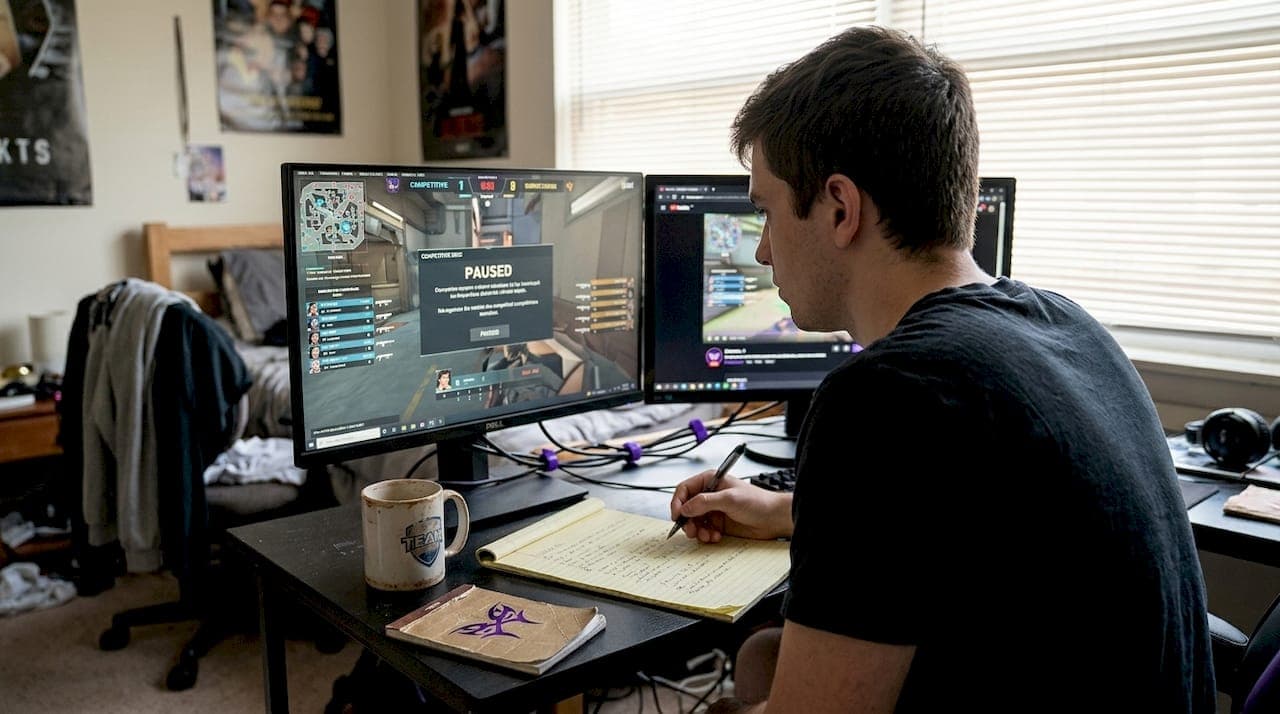
The myth that esports champions are born, not made, continues to mislead aspiring competitive gamers. While natural talent provides an initial advantage, sustainable success in professional esports requires structured skill development, deliberate practice methodologies, and data-driven performance optimization. This guide reveals the proven frameworks elite players use to progress from grassroots competitors to professional athletes, including the three-stage skill development model, evidence-based training techniques, performance analytics strategies, and viable career pathways that ensure long-term viability in the competitive gaming industry.
Table of Contents
- Key takeaways
- The three stages of esports skill development
- Deliberate practice methods to accelerate growth
- Leveraging performance data and benchmarks for competitive edge
- Career pathways and sustainable models for long-term esports success
- Start your esports growth journey with XYRA Esports
- FAQ
Key Takeaways
| Point | Details |
|---|---|
| Three stage model | Esports skills develop through Apprentice Grind Artisan phases from basic mechanics to strategic mastery. |
| Deliberate practice | Structured goal oriented training with VOD review and targeted drills yields faster improvement than random grinding. |
| Analytics driven growth | Performance data and analytics guide focused practice and strategic adaptation to win more consistently. |
| Hybrid career pathways | Diversified roles and opportunities help players sustain long term viability in a volatile industry. |
The three stages of esports skill development
Every competitive player progresses through distinct developmental phases, each requiring different focus areas and training approaches. Understanding where you currently stand and what skills define each stage allows you to create targeted improvement plans rather than practicing aimlessly.
The Apprentice stage centers on building mechanical foundations. During this phase, you're learning game-specific controls, basic movement patterns, and fundamental mechanics like aiming, ability usage, and map awareness. Your primary goal involves developing muscle memory for core actions until they become automatic. Most players spend 100-300 hours in this stage, depending on prior gaming experience and the complexity of their chosen title.
The Grind stage represents the longest and most demanding phase of development. Here, structured skill development in esports follows three stages: Apprentice (mechanical basics), Grind (deliberate practice like VOD review and aim drills), Artisan (predictive strategy and meta mastery). You're no longer learning what to do but refining how precisely and consistently you execute. This phase demands thousands of hours of focused repetition, systematic VOD analysis, and targeted weakness elimination. Players often plateau multiple times during Grind, requiring mental resilience and adaptive training strategies to push through performance barriers.
The Artisan stage separates elite competitors from skilled players. At this level, mechanics have become nearly flawless, allowing you to shift cognitive resources toward predictive strategy, opponent pattern recognition, and meta adaptation. Artisan-level players anticipate enemy movements before they happen, exploit micro-advantages in economy management, and innovate tactics that shape competitive metas. This stage requires deep game knowledge, extensive competitive experience, and the ability to synthesize information rapidly during high-pressure situations.
Self-assessment helps you identify your current stage and plan progression. Ask yourself: Do I still think consciously about basic mechanics, or are they automatic? Can I consistently execute advanced techniques under pressure? Do I understand why professional players make specific decisions, or do their choices seem random? Honest answers reveal whether you need more mechanical drilling, strategic study, or competitive experience.
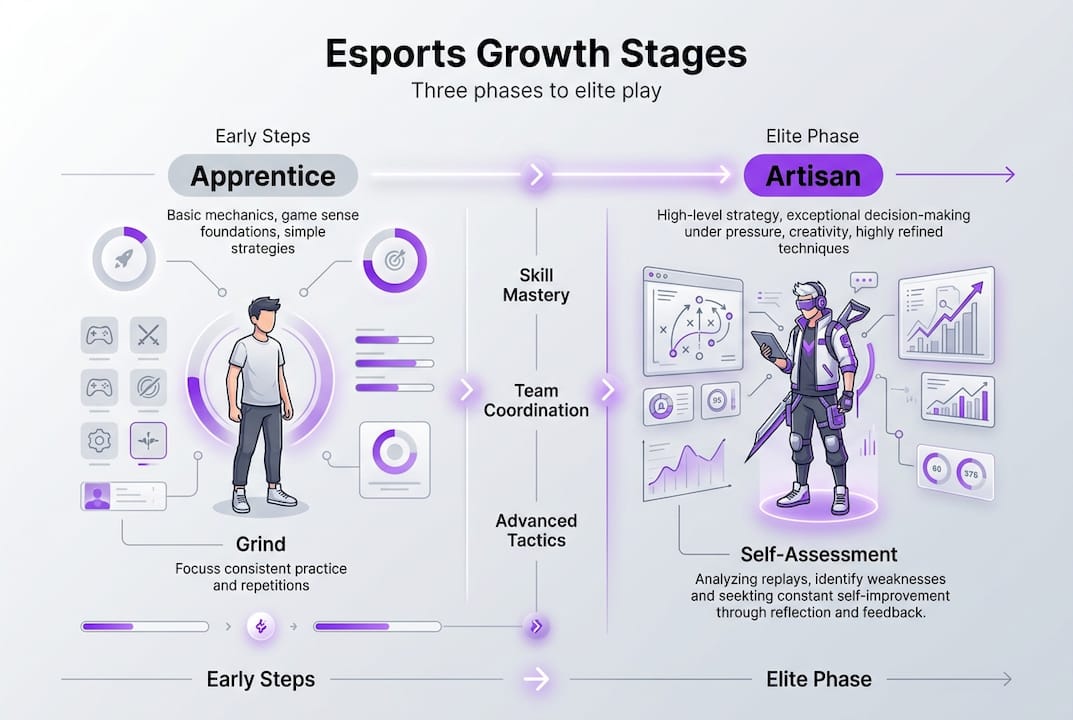
Progression through these esports training stages explained isn't strictly linear. Players often revisit earlier stages when switching roles, learning new agents, or adapting to major meta shifts. The framework provides direction, not rigid boundaries.
Pro Tip: Record yourself playing and compare your decision-making speed to professional VODs. If pros react 200-300ms faster to the same situations, you likely need more Grind-stage repetition to automate pattern recognition.
Deliberate practice methods to accelerate growth
Random grinding produces minimal improvement compared to structured, goal-oriented training sessions. Deliberate practice methodologies include goal-oriented sessions, skill isolation, VOD review, aim trainers, and mental skills integration, backed by Ericsson's research applied to esports. Each practice session should target specific weaknesses with measurable objectives and immediate feedback mechanisms.
Effective goal setting in esports transforms vague aspirations into actionable training plans. Instead of "get better at aiming," set concrete targets like "increase headshot percentage from 24% to 28% within two weeks" or "reduce average time to first kill by 0.3 seconds." Specificity creates accountability and allows you to track whether training methods actually work.
Skill isolation drilling involves practicing individual components separately before integrating them into full gameplay. If your crosshair placement needs work, spend 20 minutes exclusively on pre-aiming common angles rather than playing full matches where dozens of other factors dilute your focus. Aim trainers, movement courses, and custom lobbies enable this targeted approach. Once isolated skills reach acceptable thresholds, gradually reintroduce complexity.
VOD review remains the most underutilized high-impact practice method. Watching your own gameplay reveals decision-making patterns you can't notice during live play. Pause at every death and ask: What information did I have? What were my positioning options? Did I respect enemy utility? Compare your choices to how professional players handle similar scenarios. This metacognitive analysis builds the pattern library that defines Artisan-stage play.
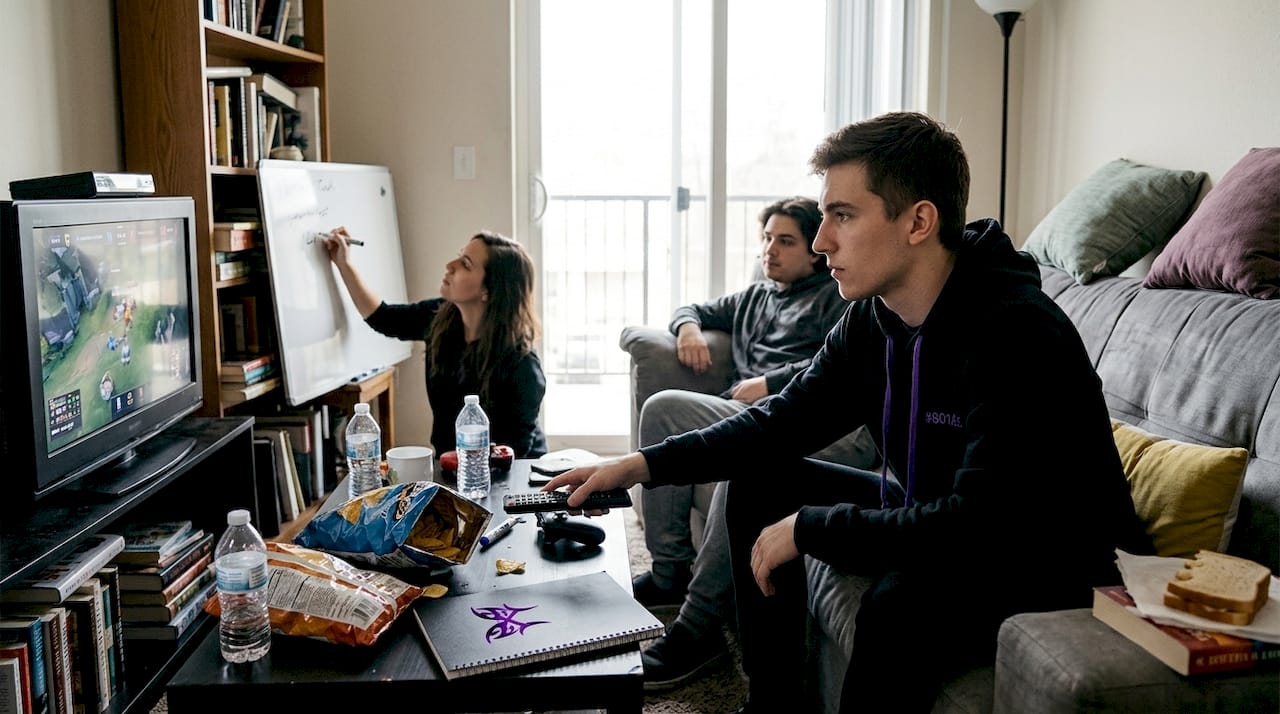
Mental skills training directly impacts performance sustainability. Visualization exercises, breathing techniques for clutch situations, and tilt management protocols prevent psychological barriers from limiting mechanical ability. Top competitors integrate mental training into daily routines, not just tournament preparation.
Managing practice fatigue requires strategic session design. The Pomodoro Technique, 50-minute focused blocks followed by 10-minute breaks, prevents diminishing returns from exhaustion. After three hours of intensive drilling, cognitive performance drops significantly, making additional practice counterproductive. Quality always trumps quantity in deliberate practice techniques.
- Set SMART goals: Specific, Measurable, Achievable, Relevant, Time-bound objectives for each practice session
- Isolate weaknesses: Drill individual skills in controlled environments before full gameplay integration
- Review VODs systematically: Analyze both wins and losses to identify decision-making patterns
- Track metrics: Maintain spreadsheets of key performance indicators to validate training effectiveness
- Schedule recovery: Plan rest days and low-intensity sessions to prevent burnout
Pro Tip: Use the 80/20 rule for practice allocation. Spend 80% of training time on your two biggest weaknesses and 20% maintaining existing strengths. Most players do the opposite, practicing what they already do well because it feels better.
Leveraging performance data and benchmarks for competitive edge
Data analytics transforms subjective feelings about performance into objective insights that guide strategic improvements. Key performance benchmarks: In Valorant VCT 2024, teams winning ≥1 pistol round win maps 70% vs 33%; higher ACS, ADR, first kills correlate with wins; CS:GO full buys win 58%; pro players peak 18-25 years. Understanding these correlations allows you to prioritize high-impact skills and strategies during training.
Average Combat Score (ACS) and Average Damage per Round (ADR) serve as foundational performance metrics across tactical shooters. ACS combines kills, assists, and multi-kill bonuses into a single number, while ADR measures raw damage output regardless of final eliminations. Professional players typically maintain ACS above 250 and ADR above 150 in competitive matches. If your stats fall significantly below these thresholds, mechanical skill development should be your primary focus.
Pistol round performance creates disproportionate impact on match outcomes. The 70% vs 33% win rate differential for teams securing at least one pistol round demonstrates how crucial these early-game situations are. Dedicated pistol round practice, including eco management strategies and post-plant positioning, offers higher return on investment than generic aim training.
First kill advantage shapes round dynamics dramatically. Teams securing the opening elimination win rounds at approximately 65% rates across major titles. This statistic validates aggressive information-gathering plays and explains why professional teams invest heavily in entry fraggers. If you struggle with first duels, isolate this specific skill through aim duels and positioning drills.
Economy efficiency separates disciplined teams from inconsistent ones. Full buy rounds in CS:GO win 58% of the time, but forced buys drop to 35-40%. Understanding when to save, force, or full buy based on opponent economy creates strategic advantages that mechanical skill alone can't overcome. Track your team's economy decisions and win rates across different buy states to identify optimization opportunities.
| Metric | Pro Benchmark | Impact |
|---|---|---|
| ACS (Valorant) | 250+ | Core performance indicator |
| ADR (Tactical FPS) | 150+ | Damage output consistency |
| Pistol Round Win % | 55%+ | Map control advantage |
| First Kill % | 52%+ | Round win probability |
| Full Buy Win % | 58%+ | Economy efficiency |
Age-related performance trends reveal optimal competitive windows. Professional players peak between 18-25 years old, with reaction time and processing speed declining gradually afterward. This doesn't mean older players can't compete, but it suggests shifting focus toward strategic roles and game sense advantages as mechanical speed decreases. Plan your career trajectory with these biological realities in mind.
Leading organizations use heatmap analysis to identify positioning patterns and exploit opponent tendencies. By tracking where enemies frequently position during specific round phases, teams develop utility lineups and pre-aim angles that maximize first kill probability. Individual players can apply similar analysis to their own VODs, identifying overused positions that opponents might predict.
Applying these insights requires systematic data collection. Use in-game stat tracking, third-party analytics platforms, or manual spreadsheets to monitor your key metrics over time. Compare your numbers against professional benchmarks and set incremental improvement targets. When specific stats plateau, adjust training focus to address the underlying skills. Esports performance analytics should inform training decisions, not replace them.
Pro Tip: Analyze your death heatmap monthly. If you die repeatedly in the same map locations, you've identified a positioning weakness that opponents will continue exploiting until you adapt.
External resources like esports data analytics platforms provide deeper statistical insights for serious competitors seeking every possible edge.
Career pathways and sustainable models for long-term esports success
Navigating from casual player to professional competitor requires understanding the structured progression path and realistic timelines involved. Career pathways: Grassroots to amateur leagues to semi-pro to pro; hybrid models (player + content/coaching) most sustainable; only ~2000 pro players globally. This scarcity makes backup plans essential, even for talented players.
Grassroots competition begins with ranked ladders, community tournaments, and open qualifiers. This stage tests your commitment and reveals whether you possess the baseline skills for higher-level play. Reaching top 500 or equivalent rankings in your title typically takes 1000-2000 hours of focused play. Most aspiring professionals spend 1-2 years at grassroots before advancing.
Amateur leagues provide structured team experience and exposure to organized competition. Platforms like ESEA, FACEIT, and game-specific challenger circuits offer tiered systems where consistent performance earns promotion. Amateur play teaches communication, role specialization, and strategic execution under pressure. Expect another 1-2 years developing these team-oriented skills.
Semi-pro status involves earning modest income through tournament winnings, small sponsorships, or academy team salaries. Players at this level compete in tier 2 and tier 3 events while maintaining part-time jobs or educational commitments. Semi-pro represents a critical decision point: commit fully to professional pursuit or develop hybrid career models that reduce financial risk.
Professional competition means earning primary income from team salaries, tournament prizes, and performance bonuses. Industry growth projections: Esports to surpass $1.9B in 2026; pro salaries $30k-$1M+; sponsorship 58% revenue. However, only the top 5-10% of semi-pros reach this level, and career longevity averages just 3-5 years due to burnout, performance decline, or roster changes.
| Career Model | Primary Income | Stability | Skill Requirements |
|---|---|---|---|
| Traditional Pro | Team salary + prizes | Low | Elite mechanics + strategy |
| Player-Creator | Content + sponsorships | Medium | Personality + consistency |
| Player-Coach | Coaching + competing | Medium | Communication + analysis |
| Full Hybrid | Multiple streams | High | Diverse skill set |
Hybrid career models offer greater sustainability by diversifying income sources. Successful hybrids combine competitive play with content creation, coaching, or community building. This approach provides financial stability during performance slumps and creates post-competition career options. Many current professionals wish they'd built content audiences earlier in their careers.
Industry challenges in 2026 include the lingering effects of the "esports winter," where reduced venture capital investment forced team budget cuts and league consolidation. While the industry still projects growth beyond $1.9 billion annually, opportunities have become more competitive. Sponsorship revenue accounts for 58% of industry income, making marketability as important as raw skill.
Building sustainable esports career progression requires strategic planning beyond just improving gameplay:
- Develop transferable skills: Communication, video editing, and strategic analysis apply to multiple career paths
- Build your brand early: Start content creation or coaching before reaching pro level
- Network actively: Relationships with players, coaches, and industry professionals create opportunities
- Maintain education: Backup credentials provide security if competitive career stalls
- Diversify income: Combine competing with coaching, content, or part-time work
Maintaining professional conduct in esports throughout your career protects your reputation and creates opportunities. Organizations increasingly value players who represent their brands positively, communicate professionally, and contribute to team culture beyond individual performance.
The path from aspiring player to sustainable esports career demands realistic expectations, strategic planning, and willingness to adapt. Success isn't just about reaching pro status but building a career that survives beyond your mechanical peak.
Start your esports growth journey with XYRA Esports
Applying the structured development frameworks, deliberate practice methods, and data-driven strategies outlined in this guide requires the right environment and support system. XYRA Esports provides aspiring and professional players with organized team structures, experienced coaching, and a community focused on long-term competitive growth rather than casual participation. Whether you're progressing through the Apprentice stage or refining Artisan-level strategy, our platform offers the resources, accountability, and competitive opportunities to accelerate your development. Visit XYRA Esports to explore how structured training, team environments, and professional guidance can transform your competitive gaming aspirations into sustainable career pathways.
FAQ
What is the most effective way to practice esports skills long-term?
The most effective approach combines deliberate, goal-oriented practice with systematic VOD review and mental skills training. Focus on quality over quantity by setting specific improvement targets for each session, isolating weaknesses through targeted drills, and tracking metrics to validate training effectiveness. Consistency matters more than marathon practice sessions; 3-4 hours of focused daily training outperforms 8-hour unfocused grinds.
How important is data analytics for improving at esports?
Data analytics provides objective insights that separate effective strategies from ineffective ones. Performance benchmarks like pistol round win rates (70% vs 33%), first kill advantages (65% round wins), and economy efficiency (58% full buy wins) reveal which skills and tactics create the biggest competitive impact. Top teams use esports performance analytics to identify opponent patterns, optimize positioning, and prioritize training focus. Individual players should track personal metrics against professional benchmarks to guide improvement efforts. Resources like esports data analytics platforms offer deeper statistical insights for serious competitors.
What career paths are available for aspiring esports players beyond pro competition?
Beyond traditional professional play, sustainable esports career progression includes content creation, coaching, team management, and analyst roles. Hybrid models combining competitive play with streaming, educational content, or part-time coaching offer greater financial stability and longer career spans than player-only paths. With only approximately 2000 professional players globally, developing diverse skills and income streams increases long-term viability in the esports industry. Many successful esports professionals transition into coaching, broadcasting, or content creation after their competitive peaks.