
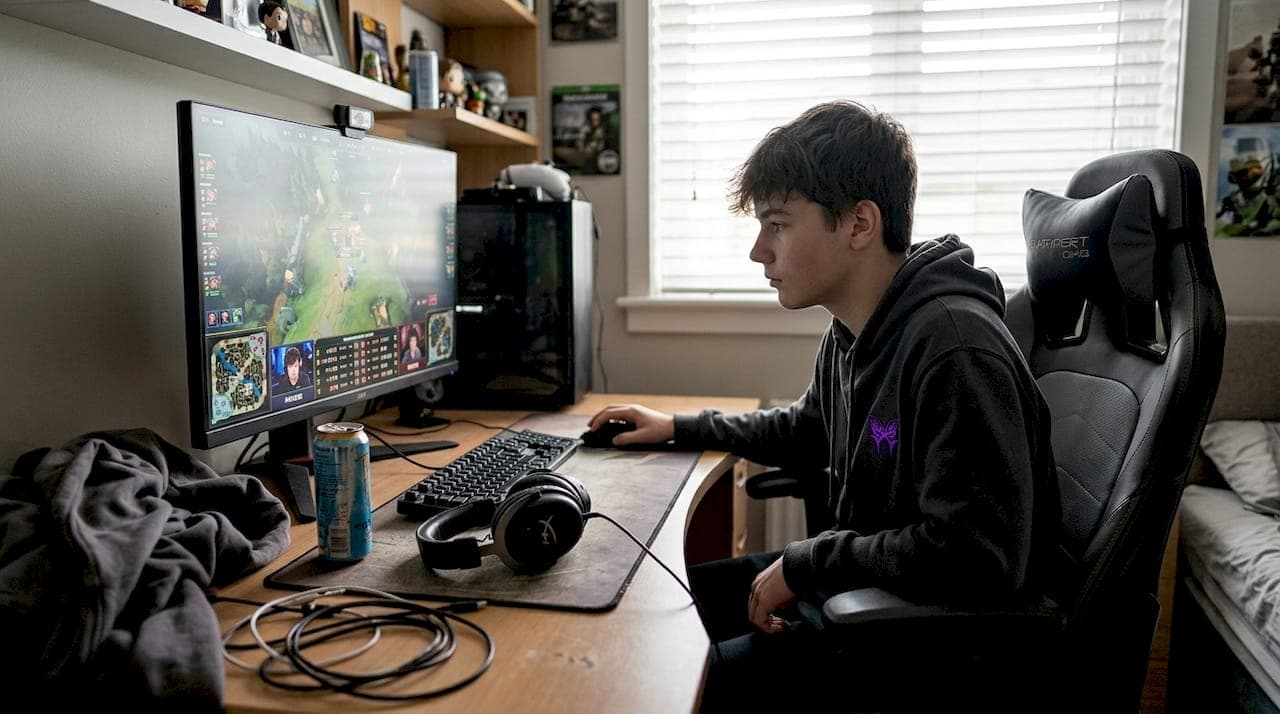
Many dedicated players grind for hundreds of hours and still hit a wall. The problem is rarely effort. It's the absence of structure. Pro success requires a holistic approach covering mechanics, tactics, and team synergy working together. This guide gives you a complete playbook built around the habits, routines, and performance metrics that top esports professionals actually use. Whether you're pushing ranked solo or preparing for organized team competition, the framework here will help you stop spinning your wheels and start making measurable progress.
Table of Contents
- What makes competitive gaming different?
- Your tools and prerequisites for success
- Proven step-by-step daily routine
- Communication and synergy: working as a team
- Tracking progress: KPIs and advanced analytics
- Common mistakes and how to fix them
- Join a discipline-driven esports organization
- Frequently asked questions
Key Takeaways
| Point | Details |
|---|---|
| Structure beats grind | Intentional routines and measurable goals outperform sheer hours spent gaming. |
| Holistic growth | Top results require honing mechanics, mindset, teamwork, and analytics together. |
| Team synergy wins | Clear communication and role discipline elevate teams far above individual skill alone. |
| Progress needs proof | Tracking KPIs and reviewing gameplay are vital for identifying strengths and weaknesses. |
| Balance prevents burnout | Integrated rest and recovery ensure sustainable development in competitive gaming. |
What makes competitive gaming different?
Casual gaming and competitive gaming look similar on the surface. Both involve the same games, the same maps, and the same mechanics. But the mindset, structure, and expectations are completely different.
Competitive gaming vs casual play comes down to one core distinction: intentionality. Competitive players don't just play. They practice with purpose, track results, and hold themselves accountable to improvement. What is competitive gaming at its core is a structured pursuit of measurable skill growth within a team or individual framework.
| Factor | Casual player | Competitive player |
|---|---|---|
| Session goal | Entertainment | Skill improvement |
| Performance tracking | None | KPIs and VOD review |
| Accountability | Self-directed | Coach or team-based |
| Routine | Unstructured | Daily regimen |
| Feedback loop | Gut feeling | Data and analysis |
Competitive players follow intentional routines with tracked performance unlike casual players who rely on feel alone. The gap between the two widens fast once structure enters the picture.
- Competitive players set session goals before logging in
- They review replays to identify specific errors
- They communicate with teammates using standardized callouts
- They measure progress with concrete metrics, not just rank
"Professional esports demands a holistic approach that integrates mechanical skill, tactical awareness, and team cohesion. No single element is enough on its own."
Your tools and prerequisites for success
Before you build a serious training routine, you need the right foundation. Equipment matters, but mindset and environment matter just as much.
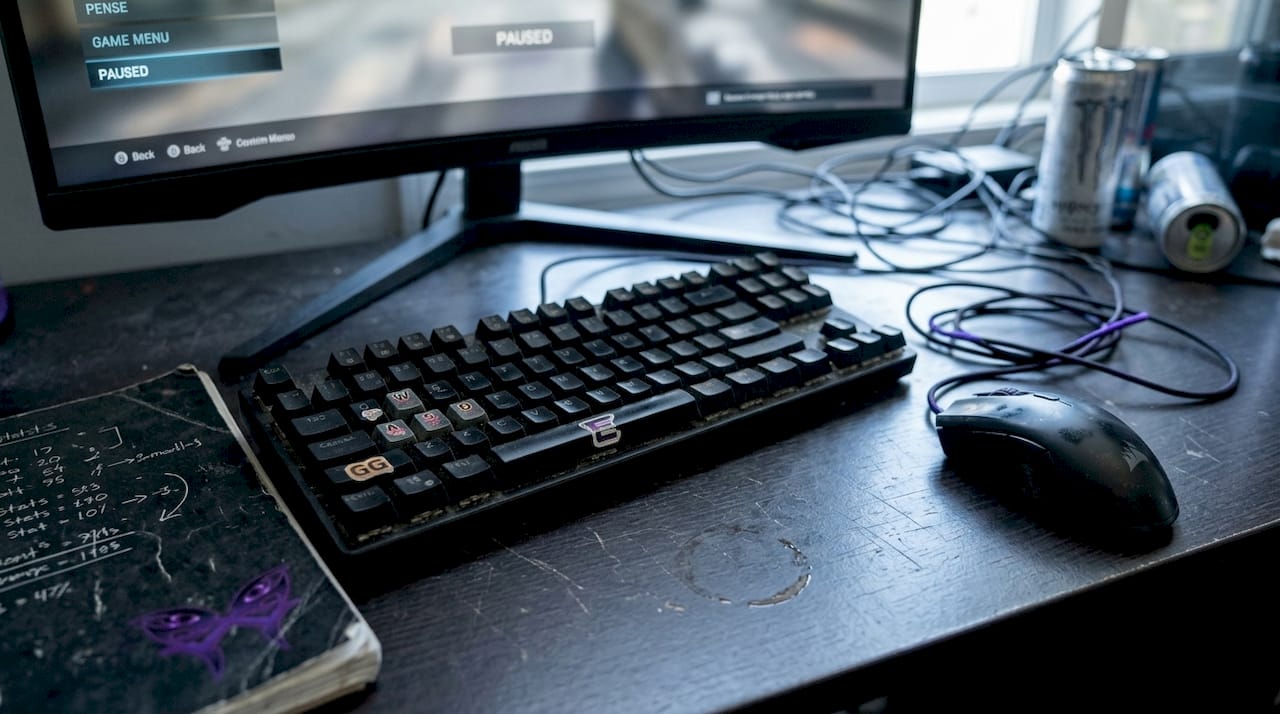
On the hardware side, your setup should match the demands of your game. A high-refresh-rate monitor, a responsive mouse, and a stable internet connection with low latency are non-negotiable for most competitive titles. Lag and input delay are performance killers you can control.
| Requirement | Why it matters | Minimum standard |
|---|---|---|
| Monitor refresh rate | Reduces motion blur and input lag | 144Hz |
| Internet latency | Prevents desync in team play | Under 30ms ping |
| Headset quality | Clear audio for callouts | Directional stereo |
| PC or console specs | Stable frame rate | 60+ FPS consistently |
Beyond gear, your environment shapes your growth. A professional gaming environment includes access to a team, a coach, or at minimum a structured online community that holds you accountable. Practicing alone with no feedback loop slows development significantly.
Mechanical mastery follows progression from isolated drills to full in-game integration. You can't skip steps. Trying to jump straight into scrims without drilling fundamentals is like running a race before learning to walk properly.
One risk worth flagging is early specialization, which can limit long-term development. Players who only grind one narrow skill set often plateau faster than those who build a balanced foundation across mechanics, game sense, and communication.
Pro Tip: Match your equipment investment to your game's demands. A battle royale player needs different peripherals than a real-time strategy player. Spend smart, not just big.
Proven step-by-step daily routine
Top pros don't just play a lot. They play with a plan. A structured daily routine is what separates players who improve consistently from those who stagnate despite high hours.
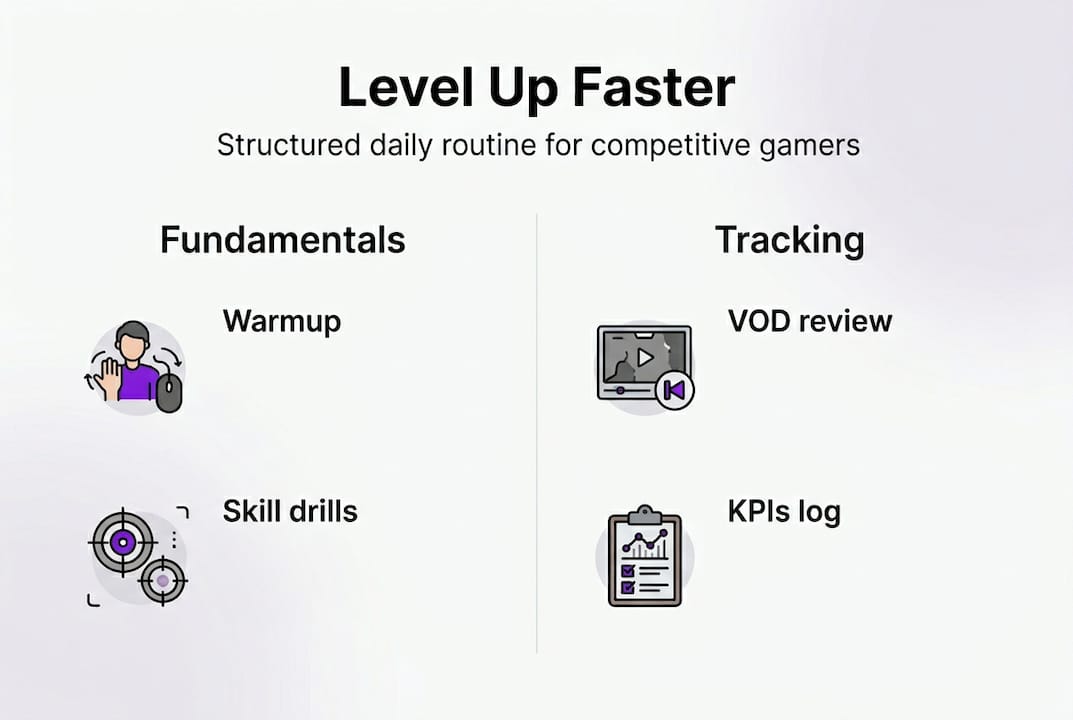
A daily pro routine spans warm-up, mechanical drills, scrims, VOD review, and physical or mental training. That totals anywhere from 6 to 10 hours of intentional effort. Every block has a purpose.
- Warm-up (30 to 60 minutes): Start with aim trainers, movement drills, or game-specific warm-up modes. This primes your reflexes and focus before real practice begins. Never skip this block.
- Mechanical drills (1 to 2 hours): Isolate specific skills. Work on flick shots, ability timing, or micro-management depending on your game. Drill progression moves from accuracy to speed to match-realistic scenarios.
- Scrims and ranked play (3 to 5 hours): This is where you apply drills under pressure. Treat every scrim like a real match. Focus on executing what you practiced, not just winning.
- VOD review (1 to 2 hours): Watch your own replays. Identify decision errors, positioning mistakes, and missed callouts. Use the step-by-step training guide framework to structure your review sessions.
- Physical and mental training (30 to 60 minutes): Stretch, exercise, and decompress. Eye strain and mental fatigue are real performance limiters. Check the esports training checklist to make sure you're covering every recovery base.
For long-term growth strategies, periodize your training. Rotate focus weeks between mechanics, team play, and mental conditioning to avoid stagnation.
Pro Tip: VOD review is where most players skip out. Watching yourself lose is uncomfortable. But that discomfort is exactly where your fastest growth lives.
Communication and synergy: working as a team
You can have the best mechanics on the server and still lose consistently if your team can't communicate. At higher levels of play, team coordination often decides outcomes more than individual skill.
Every competitive team needs a designated in-game leader (IGL) or shot-caller. This person makes real-time decisions during matches and keeps the team focused. Without one clear voice, teams default to chaos under pressure.
The CCC principle, which stands for Calm, Clear, and Concise, is the standard for competitive callouts. Designated shot-callers and standardized callouts are essential for team success at any level. Emotional or cluttered communication breaks coordination exactly when you need it most.
- Assign roles before matches so everyone knows their information responsibilities
- Standardize location callouts so there's no ambiguity mid-fight
- Track economy, objectives, and cooldowns as part of your role-based duties
- Practice communication in scrims the same way you practice mechanics
For a deeper look at how leadership structures work in organized teams, the esports leadership explained resource breaks down IGL roles and team hierarchy in detail.
"One calm, clear voice in the middle of chaos can flip a round, a map, or an entire match. Communication is a skill. Train it like one."
Tracking progress: KPIs and advanced analytics
Feeling like you're improving is not the same as actually improving. You need data. Key performance indicators (KPIs) give you an objective view of where you're growing and where you're stuck.
Survivals per round in CS2, vision and objectives in LoL, and tracked accuracy in shooters are primary KPIs across major titles. These numbers tell a story your gut feeling can't.
| Game | Key KPI | What it measures |
|---|---|---|
| CS2 | Survivals per round | Decision-making and positioning |
| League of Legends | Vision score and objectives | Map control and team contribution |
| Valorant | Headshot percentage | Mechanical precision |
| General shooters | K/D ratio and APM | Efficiency and activity level |
Beyond basic stats, advanced analytics like eye-tracking and HRV reveal patterns before successful plays and highlight cognitive load under pressure. These tools are becoming more accessible at the semi-pro level.
- Log your KPIs after every session in a simple spreadsheet
- Set weekly targets for one or two specific metrics
- Compare your stats before and after focused drill weeks
- Use replay tools built into your game client for frame-by-frame analysis
For a structured approach to measuring your growth, performance analysis in esports covers both beginner-friendly and advanced tracking methods.
Common mistakes and how to fix them
Even players with solid routines fall into traps that quietly kill their progress. Recognizing these mistakes early saves months of wasted effort.
- Neglecting rest and recovery: More hours does not always mean more improvement. Fatigue degrades decision-making and reaction time. Schedule rest days the same way you schedule practice.
- Focusing only on mechanics: Mechanics matter, but game sense, communication, and mental resilience matter equally. A player with average aim and excellent positioning will outperform a mechanical prodigy with poor decision-making.
- Ignoring team communication: Solo queue habits bleed into team play. If you never practice callouts or role-based communication, you'll struggle in organized team environments.
- Over-specializing too early: Early specialization can limit careers and increase burnout risk. Build a broad competitive foundation before narrowing your focus to one role or strategy.
The benefits of structured training become most visible when you avoid these pitfalls. Structure without recovery is just grinding. Structure with recovery is development.
Pro Tip: If you feel dread before logging in to practice, that's a burnout signal. Take a full day off, do something physical, and return with a reset mindset. Longevity in esports requires protecting your mental energy.
Join a discipline-driven esports organization
Building a structured routine on your own is possible, but it's significantly harder without accountability, coaching, and teammates who share your standards. A well-organized esports organization gives you all three. At XyraEsports, the focus is on long-term player development through structured team environments, organized coaching, and a community built around competitive growth. Whether you're looking for your first competitive team or want to sharpen your skills with serious players, the organization provides the framework to accelerate your progress. Explore the full training guide to see how structured development translates into real competitive results.
Frequently asked questions
How many hours do pro competitive gamers actually practice each day?
Top pros dedicate 6 to 10 hours daily split among drills, team scrims, VOD review, and physical or mental training. Quality and structure within those hours matter as much as the total time.
What's the fastest way to see improvement in competitive gaming?
Combine isolated skill drills with team play, track your KPIs consistently, and analyze recorded games for specific corrections rather than general impressions. Targeted feedback accelerates growth faster than raw hours alone.
How important is team communication compared to individual skill?
At higher levels, communication is as critical as mechanics. A designated shot-caller and clear callouts can decide close matches where individual skill gaps are minimal.
Which performance metrics matter most in competitive gaming?
Survivals per round and objectives are primary KPIs in major titles like CS2 and League of Legends, alongside tracked accuracy and APM for shooters and strategy games.
How do you prevent burnout as an aspiring pro gamer?
Balance intense practice with rest days, physical exercise, and non-gaming activities. Recovery and balanced routines are essential for avoiding the short careers that come from early burnout.