

TL;DR:
- Multi-title esports organizations compete across several game titles under a unified brand.
- They provide diverse career pathways, including roles in content, coaching, and player development.
- Major events like HERO ACL and Esports World Cup feature multiple titles with large prize pools.
The world's top esports organizations no longer bet everything on a single game. Instead, they field rosters across multiple titles, build unified brands, and create career pipelines that didn't exist a decade ago. Multi-title esports refers to organizations, teams, or events that compete across several different game titles rather than focusing on just one. For competitive gamers and aspiring professionals, understanding this structure isn't optional. It's the key to knowing where the real career opportunities are, how organizations sustain themselves, and how you can position yourself inside a system built for long-term growth.
Table of Contents
- Understanding multi-title esports: Structure and mechanics
- Major multi-title esports teams: Examples and impact
- Multi-title esports events: Opportunities and formats
- Benefits and career pathways in multi-title esports
- A fresh perspective: Multi-title esports is more than diversification
- Take the next step with multi-title esports organizations
- Frequently asked questions
Key Takeaways
| Point | Details |
|---|---|
| Unified multi-game brands | Top esports organizations now operate across multiple game titles, offering broad career and fanbase benefits. |
| Structured team mechanics | Multi-title orgs use divisional structures, separate rosters, and shared business operations for efficiency. |
| Event-driven opportunities | Major events reward teams and players who perform in several games, opening more paths for advancement. |
| Career benefits for pros | Players gain stability, exposure, and upward mobility by joining multi-title organizations with robust pipelines. |
| Strategic diversification | Multi-title esports organizations offset risk and grow internationally, setting new industry standards. |
Understanding multi-title esports: Structure and mechanics
So what does a multi-title esports organization actually look like from the inside? At its core, it's a business that competes in several games simultaneously while keeping everything under one brand identity. Think of it like a sports conglomerate that owns basketball, soccer, and baseball teams. Each team has its own roster and coaching staff, but they all share the same logo, sponsors, and front office.
According to multi-title esports mechanics, organizations maintain separate rosters per game title under a unified brand, with shared business operations covering sponsorships, content creation, marketing, and infrastructure. That last part matters more than most players realize. Shared infrastructure means a single content team might produce videos for five different game divisions, and a single partnership deal might fund salaries across the entire org.
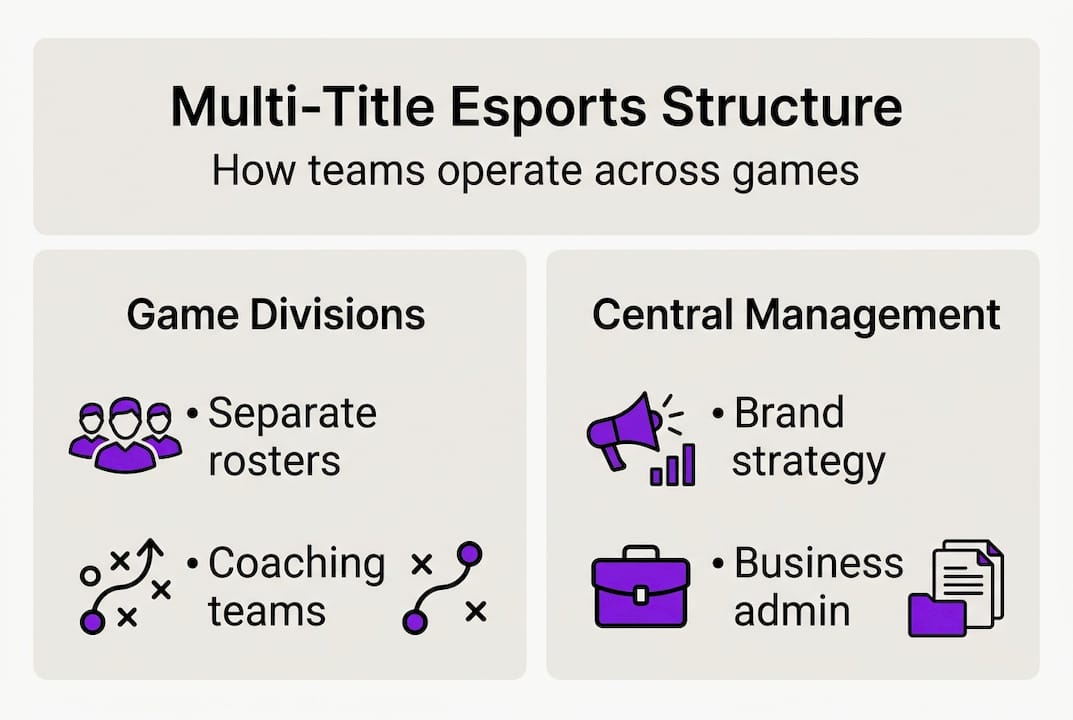
Here's a quick breakdown of how the divisional structure typically works:
| Division | Function |
|---|---|
| Competitive operations | Rosters, coaching, performance analytics |
| Content and media | Streaming, video production, social media |
| Marketing and partnerships | Sponsorships, brand deals, events |
| Business administration | Finance, HR, legal, player contracts |
For career-minded players, understanding this structure reveals something important: your path into an org isn't always through the competitive roster. You might enter through content, get noticed, and transition into a player development role. Multi-title orgs create more entry points.
Key mechanics to know as an aspiring pro:
- Unified branding keeps fan loyalty consistent across all titles
- Separate rosters mean each game division operates with its own goals and standards
- Shared sponsorships give the org financial leverage that single-title teams can't match
- Cross-title pipelines allow players to move between divisions if their primary game declines
For a deeper look at how these structures are built from the ground up, the esports organization guide breaks down the full anatomy of a competitive org. You should also review the types of esports teams to understand where multi-title orgs fit in the broader competitive landscape.
Pro Tip: When evaluating an org to join, look beyond their primary game. Ask whether they have an academy program, how many titles they compete in, and whether players can transition between divisions. That flexibility is career insurance.
Major multi-title esports teams: Examples and impact
Understanding org structures is vital, but seeing how top teams apply these mechanics gives it real-world relevance. The organizations leading multi-title esports aren't just big. They're strategically built to dominate across ecosystems.
Here's a comparison of some of the most influential multi-title organizations right now:
| Organization | Key titles | Notable strength |
|---|---|---|
| Team Liquid | LoL, Dota 2, CS2, Valorant | $56M+ in career earnings |
| TSM | Multiple titles | North American brand dominance |
| Fnatic | CS2, LoL, Valorant | European legacy and global reach |
| G2 Esports | CS2, LoL, Valorant | Entertainment-first brand identity |
| Nova Esports | Mobile titles | Asian mobile market leadership |
These organizations, including leading esports teams like Team Liquid with over $56 million in career earnings, didn't get there by accident. They built systems that let them compete at the highest level across multiple games without losing focus in any single one.
What makes these orgs worth studying as an aspiring pro:
- They set the industry standard for what a professional environment looks like
- Their fanbase size creates visibility for every player on their roster
- Their partnership networks fund player salaries, coaching staff, and facilities
- Their international presence opens doors to global tournaments and relocation opportunities
"The organizations that win across multiple titles aren't just good at games. They're good at building systems that develop talent and retain it."
For players looking to reach this level, building winning teams requires understanding the leadership frameworks these top orgs use. And mastering gaming environments is equally critical because the culture inside a multi-title org is very different from a casual team setup.

The key takeaway here is that these organizations didn't diversify just to grow bigger. They diversified to become more resilient, more attractive to sponsors, and more capable of retaining top talent even when one game's competitive scene shifts.
Multi-title esports events: Opportunities and formats
Seeing how organizations and teams operate sets the stage for understanding the events that power multi-title esports. These aren't just tournaments. They're ecosystems where career trajectories get decided.
Two events define the current multi-title landscape:
HERO ESPORTS Asian Champions League (ACL): This event features nine titles including CS2 and Dota 2, Honor of Kings, and more, with a $2 million prize pool. Winners earn direct entry to the Esports World Cup, making it a genuine career accelerator.
Esports World Cup Club Championship: This event tracks points across 21+ games and distributes $27 million in prizes across the season. That scale changes how organizations plan their competitive calendars entirely.
| Event | Titles featured | Prize pool |
|---|---|---|
| HERO ESPORTS ACL | 9 titles | $2 million |
| Esports World Cup Club Championship | 21+ games | $27 million |
How qualification typically works at these events:
- Organizations must place in the top 8 in at least two qualifying titles
- Points accumulate across the season, not just from single events
- Clubs are ranked by total performance across all titles, not just one
- Direct entry slots are awarded to top performers, bypassing open qualifiers
$27 million in prizes across 21+ games at the Esports World Cup Club Championship means individual player earnings can be life-changing, even for players in non-flagship titles.
For players and orgs alike, these events reward breadth. A team that competes in five titles has five chances to earn points, five chances to qualify, and five chances to get noticed by scouts. For esports event ideas and how to build toward these formats at a community level, there's a clear path from local events to global stages.
The format also shifts how orgs build rosters. Instead of going all-in on one game, smart organizations now scout talent in emerging titles early, knowing that multi-title events reward diversity.
Benefits and career pathways in multi-title esports
With event formats and top teams explored, let's focus on how multi-title esports creates real benefits and pathways for organizations and aspiring professionals.
For organizations, the advantages are structural. Diversified revenue from sponsorships and content, risk spreading when one title's scene declines, larger fanbases, and global presence all contribute to a more stable business model. When one game loses its major tournament circuit, a multi-title org doesn't collapse. It shifts resources.
For players, the benefits are equally significant:
- Career stability: Orgs with multiple revenue streams can afford to keep players longer
- Transition opportunities: If your primary game declines, you may be able to move to another division
- Increased visibility: Being part of a large org means more media coverage and fan exposure
- Mentorship access: Larger orgs typically have coaching staff across multiple titles
- Academy pipelines: Many multi-title orgs run developmental rosters that feed into main teams
The career pathways in esports that aspiring pros should target are specifically those within orgs that have academy programs across titles. Stability from diversified revenue directly aids player retention, which means less turnover and more time to develop.
Key stat: Organizations with diversified revenue across multiple titles are significantly better positioned to retain players through market shifts than single-title teams.
If you're serious about long-term growth in esports, you need to think about which org you join as a strategic decision, not just a competitive one. Orgs that professionalize esports teams with real structure give you a foundation that casual teams simply can't offer. The structured competitive gaming guide and step by step esports training resources can help you build the skills that make you attractive to these organizations.
Pro Tip: When choosing a multi-title org, prioritize ones with documented academy programs over those with bigger prize histories. An academy slot today is worth more than a tryout tomorrow.
A fresh perspective: Multi-title esports is more than diversification
Most guides treat multi-title esports as a business strategy. Spread across games, reduce risk, grow the brand. That framing is accurate but incomplete. It misses what this structure actually means for the people inside it.
The real value of multi-title organizations isn't diversification. It's the creation of genuine career ecosystems. When an org competes in eight titles, it needs coaches, analysts, content creators, managers, and players across all eight. That's not just more jobs. It's more types of jobs, more mentorship relationships, and more ways for a talented person to find their role.
Most players focus on whether an org is winning. Smart players ask whether the org has the structure to develop them even when they're not winning. Esports career growth happens inside systems, not just on leaderboards.
The uncomfortable truth is that orgs with academy pipelines across titles retain players longer and produce more consistent professionals. Chasing the biggest name org in one game is a short-term play. Building your career inside a structured multi-title organization is how you stay relevant for years.
Take the next step with multi-title esports organizations
If you're ready to put these insights into action, here's how to connect with leading organizations. Understanding multi-title esports is step one. Positioning yourself inside one is step two. Xyra Esports operates across multiple titles with a focus on structured development, real coaching, and competitive pipelines designed to move players forward. Whether you're a competitive player, a content creator, or someone building toward a professional career, the structure here is built to support that journey. Explore multi-title esports opportunities at Xyra Esports and find out how a disciplined, multi-title environment can accelerate your path in competitive gaming.
Frequently asked questions
What is a multi-title esports organization?
A multi-title esports organization participates in several different games, managing separate rosters under a unified brand and shared business operations. It's essentially a competitive gaming company that competes across an entire ecosystem of titles rather than betting on a single game.
How do multi-title esports teams structure their operations?
Teams use divisional structures covering competitive operations, content, marketing, and business administration, with individual rosters per game all operating under one organizational umbrella. Each division functions independently on the competitive side but shares resources like sponsorships and infrastructure.
What are the main benefits for competitive gamers in multi-title esports?
Multi-title orgs provide wider career opportunities, more stable revenue streams, and greater international exposure. Diversified revenue and global presence mean players are less vulnerable to a single game's scene collapsing.
Which major events feature multi-title competitions?
The HERO ESPORTS ACL with nine titles and a $2 million prize pool, and the Esports World Cup Club Championship spanning 21+ games with $27 million in prizes, are the two most prominent examples right now.
How can aspiring esports pros advance in multi-title teams?
Target organizations with academy pipelines across titles, diversify your competitive skills, and prioritize orgs with stable, diversified revenue over those with flashy but fragile single-game reputations.
Recommended
- Explore the main types of esports teams and how they compete
- Master long-term growth in esports: a structured guide
- Esports leadership explained: build winning teams in 2026
- What is an esports organization? A 2026 guide for players
- Master esports skin collecting guide for CS2 in 2026
- Better On the web Esports Gaming Sites - QuiTruss.com