
TL;DR:
- Deliberate, structured practice improves reaction speed and decision-making in esports players.
- Combining cognitive drills, physical exercise, and teamwork training leads to better performance and career longevity.
- Consistency and adaptation are more important than raw talent for long-term success in esports.
Talent gets you noticed. Training gets you wins. Most people assume the best esports players are simply born with faster reflexes or sharper instincts, but the data tells a different story. Experienced gamers react 30-40ms faster than casual players, and that gap is not genetic luck. It is the result of deliberate, structured practice. If you are serious about competing at a higher level, understanding why esports training works and how to apply it is the single most important investment you can make in your career.
Table of Contents
- The science behind esports training
- Key components of effective esports training
- How structured training boosts individual and team performance
- Long-term career benefits: from sustainability to professional growth
- The overlooked edge: consistency and adaptation trump raw skill
- Take your skills to the next level with structured training
- Frequently asked questions
Key Takeaways
| Point | Details |
|---|---|
| Training boosts cognitive skills | Empirical studies show structured practice enhances reaction time and decision-making in esports. |
| Holistic routines drive success | Combining physical, mental, and teamwork drills leads to better performance and sustainability. |
| Consistency beats raw talent | Long-term discipline and adaptation matter more than innate ability for advancing your esports career. |
| Team development is vital | Structured team environments foster communication, synergy, and competitive resilience. |
The science behind esports training
Let's get one thing straight: esports is not just clicking fast. It is a cognitively demanding discipline that responds to training the same way traditional sports do. Research confirms that esports training improves reaction speed and alters brain activity in regions tied to decision-making. Specifically, beta, alpha, and delta brainwave patterns shift in trained players, making their in-game choices faster and more accurate under pressure.
Physical conditioning plays a bigger role than most players expect. Studies show that structured exercise programs boost reflexes and coordination in ways that directly translate to in-game performance. An eight-week or six-week physical training program can measurably improve skills like flicking and tracking in first-person shooters. Your body and your game are connected, and ignoring one limits the other.
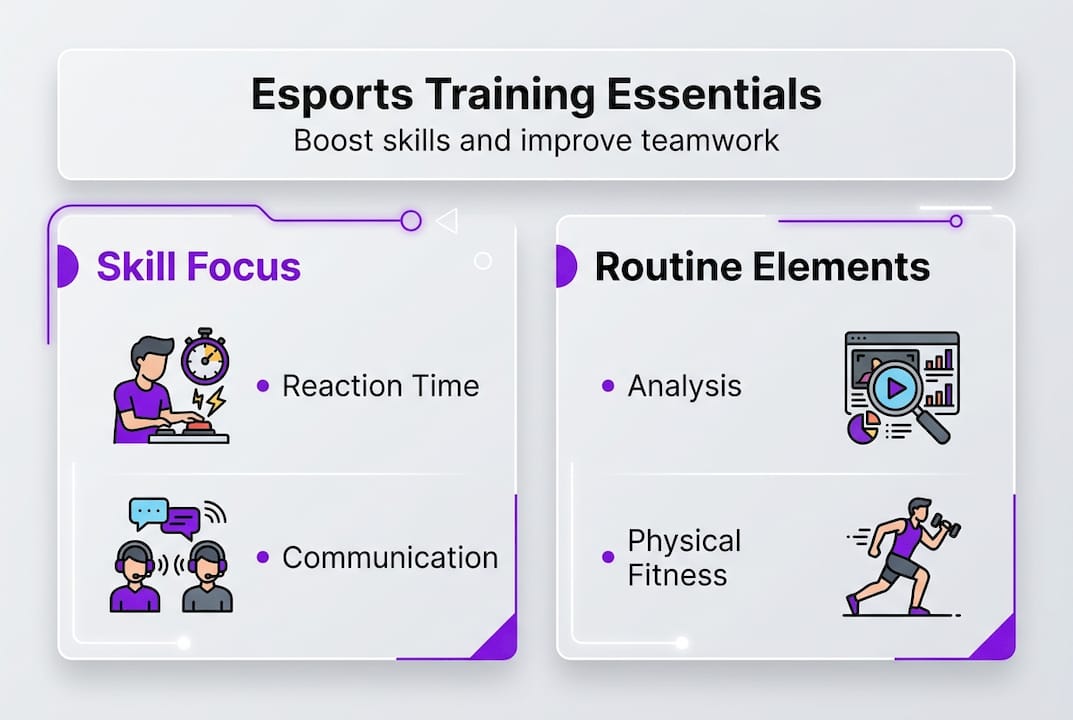
| Training type | Primary benefit | Measurable outcome |
|---|---|---|
| Cognitive drills | Faster decision-making | Reduced reaction time |
| Physical exercise | Better coordination | Improved flicking and aim |
| VOD review | Pattern recognition | Fewer repeated mistakes |
| Scrimmages | Team synergy | Higher win rate consistency |
Tools like benchmark platforms give you hard numbers to track your progress. Without measurement, you are just guessing. Tracking your aim speed, accuracy, and decision timing over weeks reveals whether your training is actually working or just keeping you comfortable.
Stat to know: Trained esports athletes show brainwave changes linked to sharper in-game decisions, not just faster fingers.
Pro Tip: Combine at least two or three days of physical conditioning per week with your in-game practice. Even 30 minutes of cardio or coordination drills significantly impacts your reaction time over a training block.
The real takeaway here is that elite performance is a system, not a trait. When you understand the science, you can build esports growth strategies that actually move the needle instead of just logging hours.
Key components of effective esports training
Knowing the science is one thing. Knowing what to actually do in practice is another. A well-structured training regimen is built from several interconnected components, and skipping any of them creates gaps in your development.
Here is what a complete training structure looks like:
- Mechanical drills: Daily aim training, movement practice, and game-specific mechanics that build muscle memory and reduce error rates under pressure.
- VOD review: Watching your own gameplay and pro matches to identify decision patterns, positioning mistakes, and missed opportunities you cannot see in the moment.
- Scrimmages: Controlled team practice against real opponents that simulate tournament conditions and expose communication weaknesses.
- Coaching and feedback: Regular sessions with a coach or experienced analyst who provides objective, data-backed assessments of your performance.
- Analytics tracking: Using in-game stats and third-party tools to measure improvement and identify specific areas that need attention.
- Mental skills work: Mindset training, focus routines, and stress management techniques that keep you performing when stakes are high.
High-performance esports environments require all of these elements working together. Facilities, coaching infrastructure, data analytics, and a focus on both individual and team development are what separate serious programs from casual setups.
Pro Tip: Use your esports training checklist to audit your current routine. If you are missing two or more components, that is likely where your plateau is coming from.
Integrating performance analysis tools into your weekly routine turns vague feelings about your gameplay into concrete data. You stop saying "I feel like I am getting better" and start proving it with numbers.
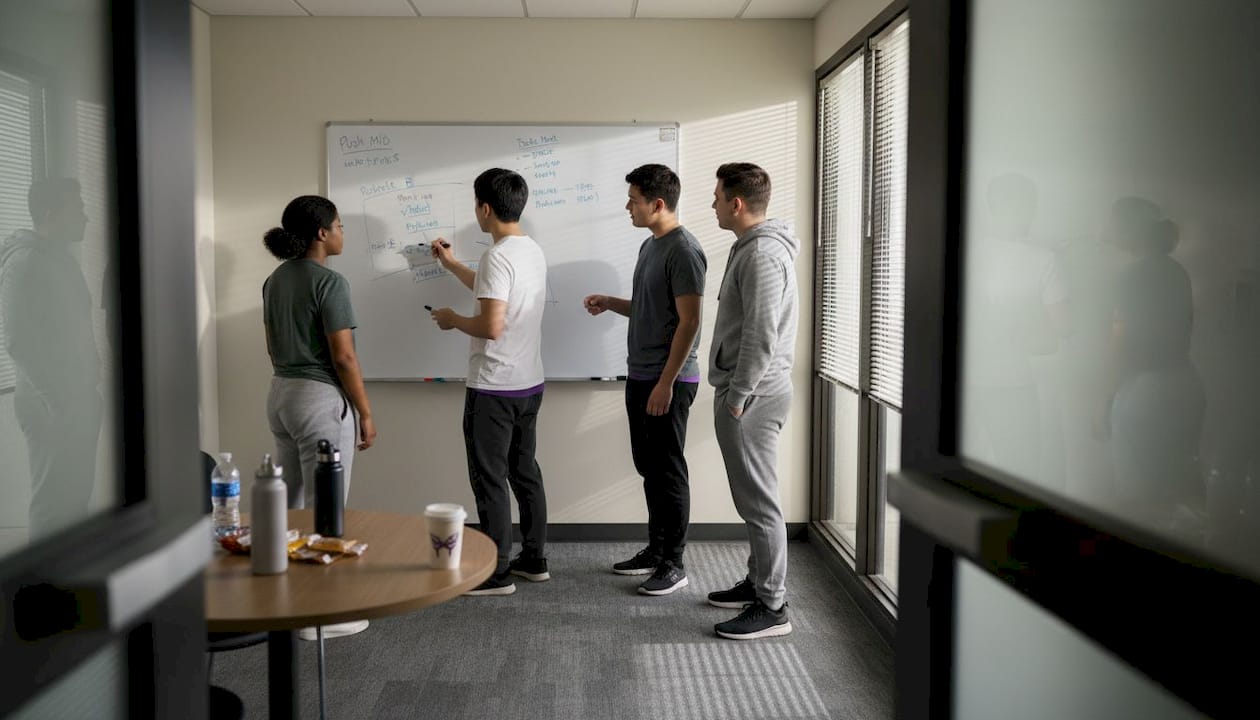
The interpersonal side of training is just as critical. Communication habits, trust between teammates, and the ability to adapt mid-game are all skills that need deliberate practice. They do not develop by accident.
How structured training boosts individual and team performance
Structure is not just about discipline for its own sake. It produces measurable results that ad-hoc practice simply cannot replicate. Let's look at what that difference actually looks like.
Individual benefits of structured training:
- Greater mechanical consistency across long sessions, not just when you are fresh.
- Faster adaptation to meta shifts because your fundamentals are strong.
- Better stress management during high-stakes matches due to routine exposure.
- Clearer self-awareness of weaknesses through regular feedback loops.
- Accelerated skill ceiling growth compared to unstructured grinding.
"Teams with structured routines and built-in feedback loops outperform informal groups across every measured performance metric."
Teams with structured routines consistently show better decision-making and stronger teamwork outcomes than groups that just queue together without a system. The difference is not talent. It is process.
| Factor | Ad-hoc team | Structured team |
|---|---|---|
| Communication | Reactive, inconsistent | Proactive, systematic |
| Adaptation | Slow, emotional | Fast, data-informed |
| Stress management | Poor under pressure | Trained and stable |
| Improvement rate | Plateaus quickly | Continuous, measurable |
Looking at competitive skills examples from high-level teams, the pattern is consistent. Players who train in structured environments develop sharper game sense, better rotations, and stronger clutch performance. That is not coincidence.
The professional environment benefits extend beyond the game itself. Players in organized teams learn accountability, time management, and how to give and receive constructive criticism. These are skills that carry into every level of competition and beyond.
Long-term career benefits: from sustainability to professional growth
Winning a tournament is exciting. Building a career is a different challenge entirely. Smart training is not just about your next match. It is about staying competitive for years without burning out or breaking down.
Here is what intentional, long-term training protects and builds:
- Physical health: Repetitive strain injuries are common in esports. Conditioning and ergonomic habits prevent the wrist, neck, and back problems that end careers early.
- Mental resilience: Structured practice includes mental recovery, not just performance output. Players who train their mindset handle losses, slumps, and pressure far better.
- Skill ceiling growth: Consistent training compounds over time. Players who train smart for two years outperform those who grind randomly for five.
- Career opportunities: Scouts, organizations, and coaching roles all favor players with documented training histories and measurable improvement arcs.
- Adaptability: As games update and metas shift, players with strong fundamentals adapt faster than those who only learned surface-level mechanics.
Physical exercise aids long-term performance stability more than short-term skill spikes. This means the players who invest in their physical conditioning now are the ones still competing at a high level years from now, while others fade out from fatigue or injury.
Key insight: Burnout is almost always a training design problem, not a passion problem. Players who structure rest and recovery into their routines stay in the game longer.
Exploring the full range of training benefits makes it clear that the ROI of structured practice goes far beyond rank. It builds the kind of player that organizations want to sign and develop.
The overlooked edge: consistency and adaptation trump raw skill
Here is something most rising talents do not want to hear: your individual flair is probably not your biggest asset right now. Your daily discipline is.
We see this pattern repeatedly. A player with exceptional mechanics hits a wall because they never developed the habit of self-review. Another player with average aim climbs steadily because they study their mistakes every single session. Guess which one gets the contract offer.
The real edge in competitive esports is not the flashy play. It is the boring, consistent work done when no one is watching. VOD review at 11pm. Aim drills before ranked. Reviewing communication breakdowns after a loss instead of blaming teammates.
Wise players invest as much in adaptation as they do in climbing. The meta changes. Patches drop. Teammates rotate. Players who build team professionalization habits early are the ones who survive those shifts instead of getting left behind.
Reframe your training for sustainable excellence. Not for this week's rank. For the player you will be in 18 months.
Take your skills to the next level with structured training
You now understand why training matters, what it should include, and how it builds both short-term performance and long-term careers. The next step is finding the right structure to put it all into practice.
Xyra Esports is built for exactly this. Whether you are looking for structured programs to guide your development or need a step-by-step training guide to build your routine from the ground up, we have the resources to help you grow. Our community is designed for competitive gamers who are serious about improvement, not just participation. Explore our blog, connect with coaches, and start building the training system that matches your ambitions.
Frequently asked questions
Does physical exercise really improve esports performance?
Yes. Targeted physical training enhances coordination and reaction time, which directly improves in-game skills like flicking and tracking for esports players.
How much can training reduce my reaction time compared to casual gaming?
Experienced esports gamers react 30-40ms faster than casual players, a gap that builds through consistent, structured training over time.
What tools do pros use to measure esports training progress?
Pros use metrics-based platforms like Aim Labs for benchmarks to track aiming speed, accuracy, and skill improvement across training sessions.
Why is teamwork training as important as individual drills in esports?
High-performance environments require team dynamics and interpersonal skills to be trained deliberately, since communication and adaptation are what separate good teams from great ones.